Reproductive Justice Program
Through the Reproductive Justice Program, NAWHERC works with a national, broad-based, and diverse coalition of Native American, women’s health, and civil liberties organizations to move forward an Agenda to protect our health and Human Rights. NAWHERC has brought to the forefront the issue of Indian Health Service’s lack of standardized sexual assault policies and protocols for sexual assault victims, documenting IHS’s violations of Native women’s right to health care and pregnancy prevention services.
NAWHERC brings Native women together through the Roundtable process to document their voices concerning the impact of Federal Indian policy on their lives. By increasing awareness of government policies that affect the daily lives of Native women, NAWHERC uses activism to promote the voices of Native women at local, national, and international decision-making levels.
NAWHERC’s reports have been used by Congress, the U.N., the World Health Organization and university and policy institutes to bring awareness of the reproductive justice issues facing Indigenous women, and by Amnesty International’s Maze of Injustice report just released April 2007, which shows the failure to protect Indigenous women from sexual violence in the United States. NAWHERC’s work has resulted in policy changes such as improvements in informed consent, the provision of patients with results for abnormal pap tests and mammograms, treatment for HIV+ patients, patient confidentiality, and the discontinuation of Norplant.In the News:
SisterSong Native Women’s Reproductive Rights and Health Roundtable Convenes
Focus Group Details IHS Response to Reproductive Health Issues
Welcome to the Indigenous Women’s Reproductive Justice and Pro-Choice Page!
The purpose of this page is to provide information concerning Indigenous women’s reproductive health and their perspectives on pro-choice issues. Throughout history, Indigenous women have interacted with other Indigenous women through various women’s societies. Traditionally, the matters pertaining to women were the business of women. All decisions concerning women’s reproductive health were left up to the woman as an individual. Her decision was respected, and it was final. Oftentimes an Indigenous woman would turn to other women within her society for advice, mentoring, and assistance concerning reproductive health.
The aboriginal people of the North Central Plains lived in not only a democracy, but also a matrilineal society when Pierre Radisson, the first white person, visited the villages in 1654. The Native women enjoyed a life unknown to white women in Europe, being free to own their own homes, participate in decisions about their government, and have control of their bodies.
In the ensuing years, the People were herded onto reservations and today live in hostage status, suffering every deprivation and loss of freedom. Our grandparents were forcibly taken from their families and sent long distances to schools where the teachings and wisdom of thousands of years of our civilization were brainwashed out of our grandparents’ generation. The insidious erosion of identity, culture, spirituality, language, scientific, technical knowledge, and power created the chaos and violence in which we, as women, struggle to survive and live a decent life. With the imposition of colonization and Christianity, foreign values, belief systems, and practices were forced upon our communities. Within those foreign systems, decisions pertaining to reproductive health were made by the Church with little regard to individual rights. Traditionally, reproductive health issues were decisions made by the individual, and were not thrusted into the political arena for any kind of scrutinization. The core of decision-making for the Indigenous woman is between her and the Great Spirit.
Within traditional societies and languages, there is no word that equals abortion. The word itself is very harsh and impersonal. When speaking to traditional Elders knowledgeable about reproductive health matters, repeatedly they would refer to a woman knowing which herbs and methods to use “to make her period come.” This was seen as a woman taking care of herself and doing what was necessary. Oftentimes women would turn to the women within her society that were the keepers of those herbs, medicines, and techniques for assistance.
With knowledge and appreciation of our history, we fully realize our status in today’s society, as we state our rights and aspirations as Native women.
Proposed IHS Policies
Proposed Indian Health Service Guidelines For Provision of Reproductive Health Care
The purpose of these policies is to provide guidance for medical professionals in the care of women’s reproductive services, especially timely services for survivors of sexual assault. Once adopted by the Indian Health Services headquarters (hereinafter “I.H.S. Headquarters”), these policies shall pertain to and be followed by all Indian Health Service Units and Emergency Rooms, Direct Care Facilities, and Contract Health Services (hereinafter “I.H.S Facilities”).
I. GENERAL PROVISIONS
a. All I.H.S Facilities shall either provide or make referrals for reproductive health services on request. I.H.S. shall pay for the cost of services resulting from all such services or referrals.
b. I.H.S. Headquarters shall establish standardized protocols for the delivery of information regarding all I.H.S. coverage for reproductive health care services.
c. I.H.S. Headquarters shall establish a Sexual Assault Management Protocol and mandate that each I.H.S. Facility post a copy of the Sexual Assault Management Protocol for attending medical staff to reference.
d. I.H.S. Headquarters shall establish standardized protocols mandating that all I.H.S. Facilities provide reproductive health care in a culturally acceptable, gender sensitive, respectful, unbiased and confidential manner.
e. All I.H.S. Facilities shall strictly maintain patient confidentiality.
f. Memoranda of Understanding between I.H.S. Headquarters and contracted facilities shall reflect and be subject to this policy.
II. CONTRACEPTIVES
a. I.H.S. Facilities shall inform women seeking to prevent pregnancy verbally and in writing of the full range of FDA – approved contraceptive options, including emergency contraception.
b. I.H.S. Facilities shall provide women with the contraceptive method of their choice, including an advance prescription for emergency contraception.
III. PREGNANCY-RELATED CARE
a. I.H.S. Facilities shall provide, in writing and verbally, all women who request information related to pregnancy options with the relevant information in a comprehensive, non-directive, unbiased and confidential manner. This will include information on:
i. Prenatal care and delivery;
ii. Infant care, foster care and adoption; and
iii. Pregnancy termination (surgical and medical).
b. I.H.S. Facilities shall inform women who request information about an abortion, provision of an abortion, or a referral for an abortion of the following:
i. I.H.S. shall pay for an abortion where the pregnancy results from rape or incest or endangers the woman’s life;
ii. Whether the Medicaid program in that state is required to cover abortions in additional situations (e.g., instances of fetal anomalies or medically necessary abortions);
iii. Whether I.H.S. and/or Medicaid are required to cover transportation costs associated with obtaining an abortion; and
iv. Available support services at I.H.S. Facilities, such as counseling and aftercare.
c. I.H.S. Facilities shall provide all needed assistance to access abortion services on-site or through contracted services to all women who request such assistance and whose pregnancy results from rape or incest or endangers the woman’s life.
d. I.H.S. Facilities shall assist women who wish to seek Medicaid coverage of an abortion in enrolling in Medicaid if eligible and in obtaining a Medicaid covered abortion.
IV. SEXUAL ASSAULT SURVIVORS
a. I.H.S. Headquarters will establish standardized, written protocols for the delivery of information and services to sexual assault survivors in a culturally acceptable, gender sensitive, respectful, unbiased and confidential manner for all I.H.S. Facilities. I.H.S. Headquarters will develop these protocols in consultation with representatives of the Native American community and national groups with expertise in assisting sexual assault survivors. These protocols should be adapted from the Department of Justice’s National Protocol for Sexual Assault Medical Forensic Examinations (available at http://www.ncjrs.gov/pdffiles1/ovw/206554.pdf), with the important addition that all sexual assault survivors be informed about and offered emergency contraception.
b. I.H.S. Facilities shall develop sexual assault treatment services by working in consultation with representatives of the Native American community served by that I.H.S. Facility and with local community groups involved in assisting sexual assault survivors (e.g., rape crisis centers, rape response teams, women’s domestic violence shelters/programs).
c. I.H.S. Facilities shall offer emergency contraception to all survivors of sexual assault and provide such contraception upon request. Providers must document this offer by having each sexual assault survivor sign a form, to be kept in her confidential patient file, acknowledging that she has been offered emergency contraception.
d. I.H.S. Facilities shall provide screening for Sexually Transmitted Infections (STI) and Reproductive Tract Infections (RTI) and shall provide STI treatment and RTI treatment to all survivors of sexual assault.
e. I.H.S. Facilities shall provide testing for HIV and shall inform all rape and incest survivors about PEP (Post-Exposure Prophylaxis).
f. I.H.S. Facilities shall inform all rape and incest survivors that I.H.S. Headquarters provides coverage for abortions where the pregnancy results from rape or incest; document the provision of this information by having each rape and incest survivor sign a form, to be kept in her confidential patient file, acknowledging that she has received this information
V. TRAINING
I.H.S. Facilities shall provide training to all relevant staff regarding the provision of reproductive health care and treatment for sexual assault patients, which includes the following requirements:
a. All I.H.S. Facility service providers shall be appropriately trained to provide services in a culturally acceptable, gender sensitive, respectful, unbiased and confidential manner. This training shall be specific to the Nation/Tribe being served.
b. Trainings shall be revised, updated, and re-administered to all relevant staff as any changes in delivery of services occur and as technological changes occur that would affect a sexual assault survivor or reproductive health patient.
c. Every I.H.S. Facility shall have one Sexual Assault Nurse Examiner or Sexual Assault Forensic Examiner (SANE/SAFE) on staff and/or on call.
d. All I.H.S. Facilities’ medical staff that has occasion to treat sexual assault victims shall be familiar with medical protocol acronyms relevant to such treatment, such as SANE (Sexual Assault Nurse Examiner); SAFE (Sexual Assault Forensic Examiner); SART (Sexual Assault Response Team); Chain of Custody (Protocol followed when working with the Sexual Assault kit.); SOR (Sexual Offense Report – specific to regions hospital); SAER (Sexual Assault Exam Report) and SO/SA (Sexual Offense/Assault).
e. I.H.S. emergency room medical professionals shall administer rape kits on-site without requiring travel or transfer to a contracted facility to perform the rape kit.
f. I.H.S. Facilities shall include current information regarding the provision of information and delivery of reproductive health services and treatment for sexual assault survivors within a staff manual.
g. I.H.S. Facilities shall promptly inform patients and all relevant staff when new reproductive health services or services for sexual assault survivors become available and when coverage of services changes.
h. I.H.S. Facilities shall establish policies, procedures, and protocols for training all relevant staff regarding the provision of information and the delivery of services described under Parts ll and lV above.
VI. DISSEMINATION OF INFORMATION TO PATIENTS AND I.H.S. STAFF
I.H.S. Facilities shall:
a. Inform all patients and relevant staff of what reproductive health services I.H.S. Facilities provide and what reproductive health services I.H.S. Headquarters covers (including, but not limited to abortion, emergency contraception, the full range of FDA-approved contraceptive drugs and devices, services and treatments for survivors of sexual assault.)
b. Amend the Patients’ Bill of Rights to inform women of their right to obtain the full range of FDA – approved contraceptives (including Emergency Contraception), non-directive pregnancy options counseling, PEP and I.H.S. coverage of abortions (surgical and medical) in certain circumstances.
c. Post the amended Patients’ Bill of Rights in every I.H.S. Facility throughout all patient waiting rooms or other areas where patients are regularly received for intake and/or provided care.
d. All policies, procedures, and protocols must be posted and accessible to medical staff, in the emergency room. Emergency room medical personnel shall receive Sexual Assault treatment protocols upon new hire and appropriate training/understanding of protocols. Staff shall be required to review policies, procedures and protocols on a regular basis.
VII. RECORD KEEPING
I.H.S. Facilities shall maintain and report to I.H.S. Headquarters the following data, in a manner that maintains the confidentiality of all patient records and identifying information:
a. The number of women who came in for health services after experiencing incest, rape, or other sexual assault, how many of those women were offered emergency contraception, and how many of those women accepted emergency contraception.
b. The number of women who requested information about an abortion and the number who requested an abortion. For those women who requested an abortion, the number of women who:
i. Received a referral for an abortion;
ii. Had an abortion performed at an I.H.S. Facility;
iii. Sought an abortion because they were pregnant as a result of rape;
iv. Sought an abortion because they were pregnant as a result of incest;
v. Sought an abortion because continuation of the pregnancy endangered their life;
vi. Were Medicaid-eligible and received assistance from an I.H.S. Facility in obtaining an abortion; and
vii. Obtained Medicaid coverage of an abortion.
c. The gender identity of each sexual assault patient.
VIII. REVIEW AND AUDIT
I.H.S. Headquarters shall require all I.H.S. Facilities to establish a review/audit process by which it will ensure that the protocols developed pursuant to the above items are followed at all I.H.S. Facilities. The review/audit process should include, but not be limited to, an evaluation of whether Facilities have kept records or can provide proof to establish that:
a. Patients seeking to prevent pregnancy have received emergency contraception information/prescription;
b. Sexual assault victims have been offered counseling;
c. A sexual assault victim’s advocate was contacted and whether or not she/he was present when a sexual assault patient was treated;
d. The number of sexual assaults presenting annually in the emergency room;
e. Patients have been informed that if a pregnancy resulted from a rape, I.H.S. will provide coverage for an abortion;
f. The number of requests for abortion and/or information requests regarding abortion;
g. The number of abortions provided by an I.H.S. Facility;
h. A SANE/SAFE is in place or on-call at every I.H.S. Facility; and
i. SANE/SAFE training is current and comprehensive and occurs on a yearly basis.
Reproductive Justice Agenda
Native Women for Reproductive Justice
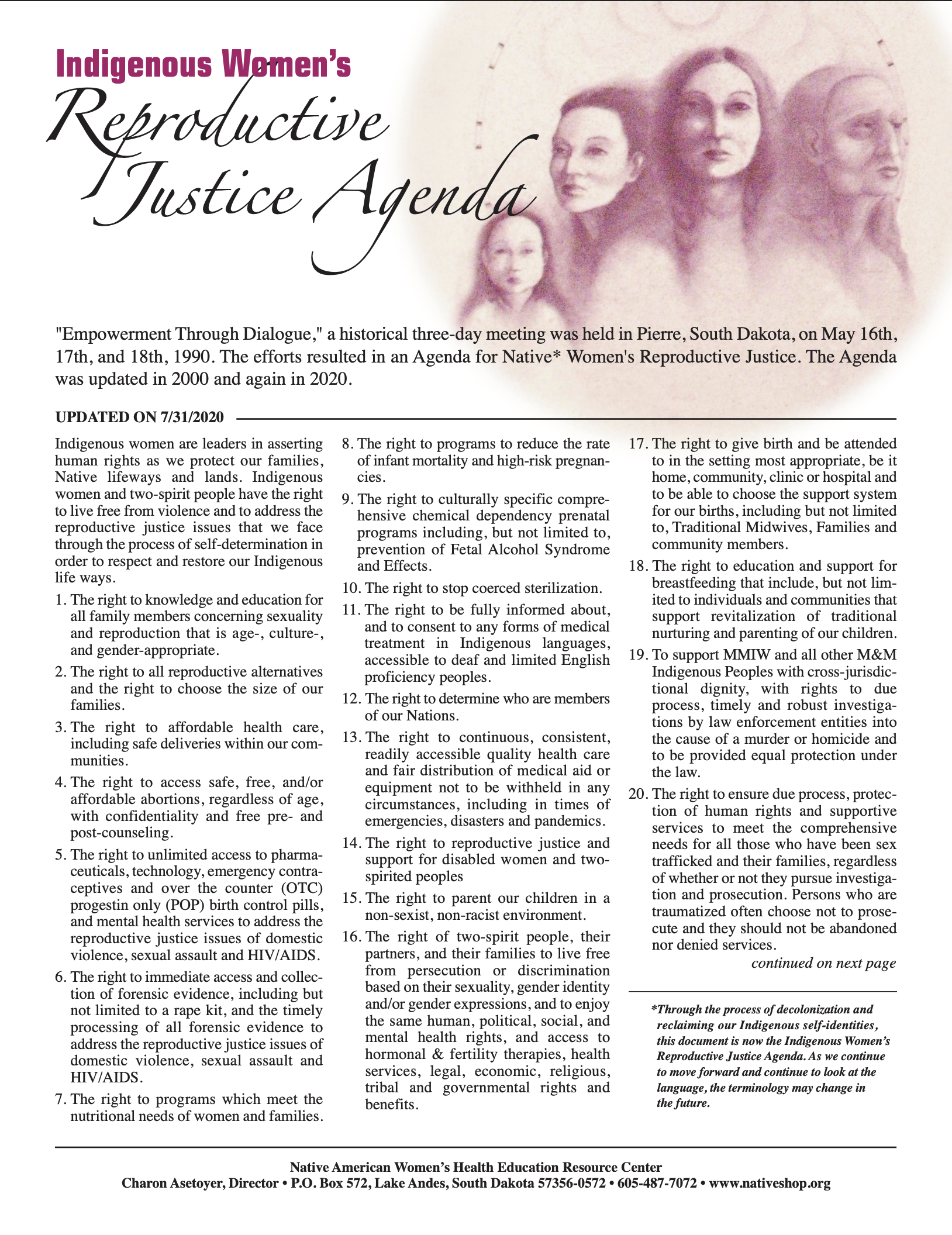
“Empowerment Through Dialogue,” a historical three-day meeting was held in Pierre, South Dakota, on May 16th, 17th, and 18th, 1990. More than 30 Native Women, representing over eleven Nations from the Northern Plains came together in a collective decision-making process to form a Reproductive Justice Coalition. Their efforts resulted in an Agenda for Native Women’s Reproductive Justice.
Reproductive Justice Agenda:
The right to knowledge and education for all family members concerning sexuality and reproduction that is age-, culture-, and gender-appropriate.
The right to all reproductive alternatives and the right to choose the size of our families.
The right to affordable health care, including safe deliveries within our communities.
The right to access safe, free, and/or affordable abortions, regardless of age, with confidentiality and free pre- and post-counseling.
The right to active involvement in the development and implementation of policies concerning reproductive issues, which include but are not limited to pharmaceuticals and technology.
The right to include domestic violence, sexual assault, and AIDS as reproductive justice issues.
The right to programs which meet the nutritional needs of women and families.
The right to programs to reduce the rate of infant mortality and high-risk pregnancies.
The right to culturally specific comprehensive chemical dependency prenatal programs including, but not limited to, prevention of Fetal Alcohol Syndrome and Effects.
The right to stop coerced sterilization.
The right to a forum for cultural/spiritual development, culturally-oriented health care, and the right to live as Native Women.
The right to be fully informed about, and to consent to any forms of medical treatment.
The right to determine who are members of our Nations.
The right to continuous, consistent, and quality health care for Native People.
The right to reproductive justice and support for women with disabilities.
The right to parent our children in a non-sexist, non-racist environment.
The right of Two Spirited women, their partners, and their families to live free from persecution or discrimination based on their sexuality and/or gender, and the right to enjoy the same human, political, social, legal, economic, religious, tribal and governmental rights and benefits afforded all other Indigenous women.
The right to give birth and be attended to in the setting most appropriate, be it home, community, clinic or hospital and to be able to choose the support system for our births, including but not limited to, Traditional Midwives, Families and community members.
The right to education and support for breastfeeding that include but not limited to, individuals and communities that allow for regrowth of traditional nurturing and parenting of our children.
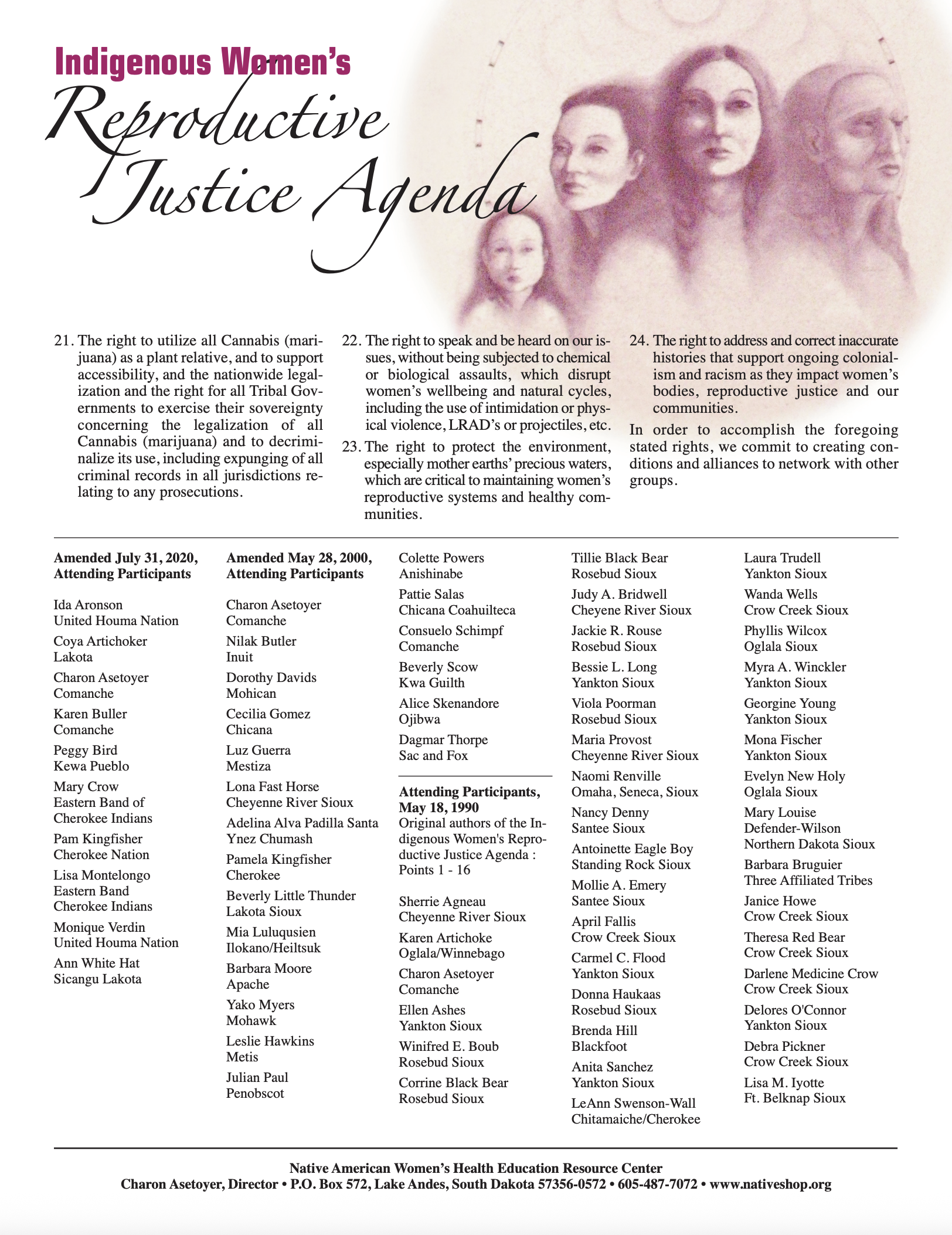
In order to accomplish the foregoing stated rights, Native Women for Reproductive Justice will create conditions and alliances to network with other groups.
Attending Participants, May 18, 1990
Authors of the Indigenous Women’s Reproductive Justice Agenda : Points 1 – 16
Sherrie Agneau
Cheyenne River SiouxViola Poorman
Rosebud SiouxAnita Sanchez
Yankton SiouxBarbara Bruguier
Three Affiliated TribesKaren Artichoke
Oglala/WinnebagoMaria Provost
Cheyenne River SiouxLeAnn Swenson-Wall
Chitamaiche/CherokeeJanice Howe
Crow Creek SiouxCharon Asetoyer
ComancheNaomi Renville
Omaha, Seneca, SiouxLaura Trudell
Yankton SiouxTheresa Red Bear
Crow Creek SiouxEllen Ashes
Yankton SiouxNancy Denny
Santee SiouxWanda Wells
Crow Creek SiouxDarlene Medicine Crow
Crow Creek SiouxWinifred E. Boub
Rosebud SiouxAntoinette Eagle Boy
Standing Rock SiouxPhyllis Wilcox
Oglala SiouxDelores O’Connor
Yankton SiouxCorrine Black Bear
Rosebud SiouxMollie A. Emery
Santee SiouxMyra A. Winckler
Yankton SiouxDebra Pickner
Crow Creek SiouxTillie Black Bear
Rosebud SiouxApril Fallis
Crow Creek SiouxGeorgine Young
Yankton SiouxLisa M. Iyotte
Ft. Belknap SiouxJudy A. Bridwell
Cheyene River SiouxCarmel C. Flood
Yankton SiouxMona Fischer
Yankton Sioux Jackie R. Rouse
Rosebud SiouxDonna Haukaas
Rosebud SiouxEvelyn New Holy
Oglala SiouxBessie L. Long
Yankton SiouxBrenda Hill
BlackfootMary Louise Defender-Wilson
Northern Dakota Sioux
Amended May 28, 2000: Points 17 – 19
Attending Participants
Charon Asetoyer
ComancheLona Fast Horse
Cheyenne River SiouxBarbara Moore
ApachePattie Salas
Chicana CoahuiltecaNilak Butler
InuitAdelina Alva Padilla
Santa Ynez ChumashYako Myers
MohawkConsuelo Schimpf
ComancheDorothy Davids
MohicanPamela Kingfisher
CherokeeLeslie Hawkins
MetisBeverly Scow
Kwa GuilthCecilia Gomez
ChicanaBeverly Little Thunder
Lakota SiouxJulian Paul
PenobscotAlice Skenandore
OjibwaLuz Guerra
MestizaMia Luluqusien
Ilokano/HeiltsukColette Powers
AnishinabeDagmar Thorpe
Sac and Fox
In appreciation to the Women of Color Partnership Program of RCAR of Washington, D.C., and the Native American Women’s Health Education Resource Center of Lake Andes, South Dakota, for co-sponsoring this meeting, and to the Ms. Foundation for continued support.
Reproductive Justice Reports
Free the Pill Available Online
Indigenous Women’s Dialogue – Roundtable Report on the Accessibility of Plan B as an Over The Counter (OTC) Within Indian Health Service – February 2012 Available Online
A Survey of the Availability of Plan B and Emergency Contraceptives within Indian Health Service. 2008. Available online
Over the years Indian Health Service has denied Native women the same options of birth control that is afforded to mainstream women. IHS has provided a narrow set of options that in many cases has forced Native women into sterilization that would not have done so if other options were available. The lack of standardized policies that govern reproductive services within this Federal system has allowed this history of Human Rights abuses to occur. It has denied Native women services that other women have access to. As in the case of emergency contraceptives this situation has created an environment that forces women to carry unplanned and unwanted pregnancies to term. This situation has occurred in history during Hitler’s years of control in Germany, when women were raped and forced to have babies for the Third Reich and when Black women in the US were raped by slave masters to produce more children to be forced into slavery. Forcing women to have children against their will is an act of slavery and denying them health care and services to terminate a pregnancy under these circumstances are truly Human Rights violations. This survey examines the access and inconsistent application of emergency contraceptives within the Indian Health Service system.
Roundtable Report on the Availability of Plan B and Emergency Contraceptives within Indian Health Service. February 2012. Available online
The Indian Health Service (IHS) clinical manual states that “all FDA-approved contraceptive devices should be available” to its patients. 9 However, despite the fact that Plan B® has been FDA-approved for nearly a decade and ruled safe for over-the-counter use since 2006, the Resource Center’s January 2008 study A Survey of the Availability of Plan B® and Emergency Contraceptives Within Indian Health Service shows that EC and Plan B® are still not adequately available at Indian Heath Service facilities.10 To date, a mere 10% of surveyed IHS pharmacies have Plan B® available OTC. Plan B® was not available–even with a prescription–at 50% of the pharmacies in the study. At 37.5% of these pharmacies, the older Yuzpe regimen was offered instead; the remaining 12.5% of IHS facilities still had no form of EC available at all.
A Survey of Sexual Assault Policies and Protocols within Indian Health Service Emergency Rooms. 2005. Available online
It is important to understand that for most Native American women private health care is unaffordable, so the Indian Health Service serves as our primary health care provider. For Native American people health care is not a privilege, it is a right. It is a right granted in exchange for land seized and is defined by treaties written by the United States Government. The staff of the Native American Women’s Health Education Resource Center is known for taking on the role of activist in order to help Native American women receive better and improved health care. The Resource Center has put together this briefing paper on emergency room services and policies for Native American women who go to an Indian Health Service facility for assistance after a rape or sexual assault. The findings of this survey are alarming and document a substantial gap in services for Native American women.
Roundtable Report on Sexual Assault Policies and Protocols within Indian Health Service Emergency Rooms. 2005. Available online
In October 2002, the Native American Women’s Health Education Resource Center (NAWHERC) released findings that the Indian Health Service (IHS) was not providing lawful abortion services under the Hyde Amendment to Native American women. The findings underscored the fact that Native American women’s health care and rights are in jeopardy. In 2003, representatives from the U.S. and Canada gathered for a Roundtable on access to abortion and provided recommendations for action at the national, international, and community levels. Since then, NAWHERC has partnered with the National Abortion Federation (NAF), the American Indian Law Alliance, the American Civil Liberties Union (ACLU), Cangleska Inc., the Center for Reproductive Rights and other advocacy and women’s health organizations to ensure that treaty-negotiated women’s reproductive health care through IHS remain accessible to Native American women.
#001 Indigenous Women’s Reproductive Rights: The Indian Health Service and Its Inconsistent Application of the Hyde Amendment
Traditional Native American customs left the issue of abortion in the hands of the woman facing the choice; the decision was hers alone and was not, as it is today, imposed upon by impersonal governmental policy. Although illegal abortions can be extremely dangerous due to the lack of proper and sterilized equipment, abortions were not legalized in the United States until 1973. At the time, a federal account was specified in order to fund abortions for women on Medicaid or those who received health care through IHS. In 1976, the Hyde Amendment was established, and limited federal funding to abortions where a woman’s life was threatened physically. A 1997 revision to the Hyde Amendment allowed financial aid in cases where rape or incest caused the pregnancy. The report goes on to discuss individual states’ ability to determine Medicaid policies and thus, the ability to expand or restrict funding for abortions. Regardless of whether a state is able to expand its Medicare policy, Native American women are still constrained by the Hyde Amendment. Given their rights under the Hyde Act, however, IHS abortion policy in practice is yet more limiting. A survey conducted by Native American Women’s Health Education Resource Center found that 85% of the IHS units surveyed were “noncompliant with official IHS abortion policy” and 62% stated that they do not provide abortions even in the case of life endangerment. Although IHS Chief Medical Officer permits the use of Mifeprex (RU-486, the abortion pill), not one of the units surveyed carried the drug in stock. The report includes a brief description of RU-486 and ends with a plea to IHS and other organizations to at least provide the health care guaranteed to women by the constitution and the Hyde Amendment.
#002 Indigenous Women’s Reproductive Rights: Roundtable Report on Access to Abortion Services through the Indian Health Service under the Hyde Amendment
The state of South Dakota has been known to be conservative, and it is extremely difficult for a woman to obtain abortion services here. In fact, only one private abortion clinic, located in Sioux Falls, exists in the entire state. Indian Health Service, under the directive of the Department of Health and Human Services, is required to follow federal abortion policy that permits federal financial aid in cases of rape, incest, or life endangerment; they have failed to provide these guaranteed services in the past. Since 1981, a mere twenty-five abortions have been performed by the 352 IHS units established nationwide, a figure that is hugely disproportionate to the number of rapes reported by Native American populations. The issues covered in this report include the massive turnover rates of physicians at IHS, a phenomenon that results in a sexist, cultural, and religious bias. These traveling doctors have few connections with the communities in which they work, and their impersonal outlook helps muddle the question of whether a patient’s case fulfils the requirement of rape, incest, or life endangerment needed to obtain the necessary abortion. The report includes recommendations for involving the Native American community in actions for change and ways to work specifically with, as well as potential challenges in working with, Native American populations. An outline guides the reader through the group’s strategy for approaching individual IHS units, and finally, moving on to an international scale.
#419 The Current Status of Indian Health Services Reproductive Health Care: Report #1: A Focus Group Examining the Indian Health Service’s Reproductive Health Care for Native American Women in the Aberdeen Area
This focus group study featured eight women, between ages 18-37, from six different Lakota and Dakota nations, who used IHS as their primary health care providers. The purpose of the study was “to bring awareness to IHS’s present delivery of services to Native American women,” to examine IHS policy and protocol, and to see if women who receive care there felt well informed of their condition, medication, and capable of administering to themselves afterwards. A study such as this also helps initiate formal dialogue between IHS and their patients. The report includes a brief history of IHS, funding, and an echo of the IHS mission statement. Statistics comparing the health of Native Americans with all other races indicates a much lower health status. Many women questioned mentioned the lack of information presented to them during their hospital visit. The physicians seem to have no interest in educating their patients about short-long term effects of various RTIs or prevention methods, and this type of attitude leads to women making uninformed decisions about the birth control device appropriate for them. Instead, they often report feeling pressured to use certain kinds of contraceptives, particularly long-term types. Even more shocking is the fact that the men and women these patients see are sometimes not physicians at all but practicing PAs or fraudulent doctors not in good standing with their certification board. IHS also has a history of severely violating their oath of confidentiality to the point where pregnant women delay seeking prenatal care in order to delay informing the public of the news of their pregnancy. The report includes a review of IHS health care practices and a discussion of the implications of the focus group’s dialogue.
#003 Young Native American Women’s Knowledge of Reproductive Tract Infections: Report #2: A Focus Report Examining the Reproductive Health Awareness of Young Native American Women in the Aberdeen Area
Written between June-July in 1999, this report examines the level to which young Native American women in the Aberdeen area have been educated on the topic of common reproductive tract infections. The Resource Center has been concerned by the high incidence of RTIs reported in the communities, and, in the process of this report, conducted a focus group discussion with 27 young women between the ages of 14-19 years from seven different Lakota and Dakota nations. The intent of the discussion was to empower the girls’ voices through publication, thus allowing their words to reach school officials, counselors, and policy makers, as well as directly affecting the direction of the Resource Center’s educational programs’ curriculum. The report includes a brief explanation of RTIs and a paragraph on the history of sexual education policy at the area schools. The listed questions were put to the girls in a near survey style, and their responses are reported as quotes. The study found that there was little clarity about the terms RTIs, STDs, and even HIV/AIDS due to the lack of effective or consistent sex-education in schools. Group leaders also recorded the girls’ primary sources of information and their suggestions for improving sex education curricula. The discussion placed a clear emphasis on culturally specific and appropriate health education, and recommendations include proposals for involving the community and schools in future programs.
#414. The Dakota Roundtable: A Report on the Status of Native American Youth in the Aberdeen Area
The Dakota Roundtable was part of the Native American Women’s Leadership Development Program initiated by Native American Women’s Health Education Resource Center. In May of 1993 twenty-eight representatives from Lakota, Dakota, Omaha, and other nations in the states of South Dakota, North Dakota, Iowa, and Nebraska met to discuss the unrealized health needs within their communities. The committee’s goals were to identify and develop recommendations for the existing issues in their communities and to improve partnerships and policy-making strategies; they also intended to promote political activism, creative problem-solving skills, and leadership roles among young women. To better identify specific needs of the community, the group was divided into three sections defined by children’s developmental stages. The first group focused on ages 0-5 yrs. and discussed matters such as a mother’s ability to access health care resources, substance abuse and its consequences, parenting skills, teen pregnancies and family planning programs, and the presence of violence in the household. The next group battled, through debate, concerns for the 6-12 age group such as domestic violence, physical health basics, child-care and parenting, the definition of health as put forth by indigenous people, and the lasting effects of colonialism. The final group discussed the health of children from ages 13-21 and the pressures of their lives, such as pregnancies, drug abuse, violence, and suicide. The recommendations made by each assembly are recorded at the end of the report.
#414A. Dakota Roundtable II: A Report on the Status of Native American Women in the Aberdeen Area
The Dakota Roundtable II was held in Sioux Falls in September of 1994 and was intended as a forum, a safe environment, in which participants could openly share their experiences as Native American women. The meeting also provided an opportunity for organizations to build partnerships, develop strategies to maneuver the issues discussed into the policy-making domain, and to advance leadership roles for women in the community. The assembly divided into three sections to discuss Health Issues Facing a Native American Woman, the Traditional Ways of Being a Native American Woman, and Violence and Abuse Issues. The first topic included concerns such as the state of existing health and medical programs, diseases such as diabetes that are prevalent in the race, and other health issues such as reproductive rights, menopause, and domestic violence. This group also included a brief section on medical attitudes and unethical research practiced on Native American women. The second section recorded their thoughts in a unique memoir style, as accounts told by participants. The women attempted to define the meaning of “traditional Indian,” and spoke of the role of and importance of language, culture, and historical names and labels. They further discussed elitism and class-ism and the place of tradition within this imposed structure. Spurred by the fact that although Native Americans only make up 6.9% of the population in South Dakota nearly 50% of all domestic abuse reports come from Native American households, the final group focused on spousal violence and “formalized, institutionalized abuse” by the community. In addition, they wrote of the lack of recognition for a woman’s work, lack of leadership roles for women, discrimination in public schools, and a variety of issues at the workplace.
#414B. Dakota Roundtable III: A Report on the Status of Young Native American Women in the Aberdeen Area
The third in its series, the Dakota Roundtable III was held in Sioux Falls in April 1996. Organized a bit differently from the previous ones, this one featured a forum for sixteen girls, age 12-19, from the tribes of Crow Creek, Lower Brule, Rosebud, Santee, Sisseton, Wahpeton, and Yankton. Before splitting into smaller groups, the girls spoke in an open dialogue of the difficulties they have perceived in their daily lives. While the younger girls listed issues such as prejudice, ignorance among their peers about their culture, and smoking and drugs, the older girls went on to mention the complexities of being a single parent with little financial or emotional support from a spouse, and the pressure to succeed put forth by one’s family as opposed to the stereotyped roles imposed on them by society. One group discussed the effects of drugs and alcohol on female teens, including relationships with drinking parents and friends, personal views and experiences with drinking, tragedies, violence, and reasons for indulging in drugs. A second group spoke of issues faced by teen mothers, such as personal and familial responses to the event, drugs taken during pregnancy, financial instability, housing, and childcare. The final topics discussed incorporated the issues of racism and prejudice. The report relates points of racism experienced by the team itself while stationed in Sioux Falls for the conference as well as the anecdotes told by the participating girls. They noted the effects of relationships within their families on their own personal outlook, attitudes on interracial dating, and power interplay between the races prior to the introduction of violence into any situation. A 1994 survey on Native American sexual health revealed startling results that are discernible in this study as well. For example, a massive 92% of sexually active girls reported being forced into sexual intercourse on a date, and 67% have been pregnant by the end of their senior year in high school. Within the age group 15-19, 50.6 out 100 girls have one or more children.
#403 The Impact of Norplant in the Native American Community
Norplant became available in 1991 in the United States and within a year had cornered 12% of the U.S. contraceptive market. Written in 1992, this report recognizes the potential for social control present in the method of delivery of Norplant and attempts to differentiate for the reader the issues of reproductive choice and population control. It includes a background of the drug and a summary of concerns, such as the lack of information available that pertains directly to Native Americans and their limited access to Norplant removals. Although Norplant is extremely effective compared to other hormonal contraceptives, several side effects, such as decreased efficacy in women of greater weights and prolonged menstrual cycles, make it an inappropriate choice for many women. Add to this the fact that the drug is downright dangerous for women with diabetes and blood pressure problems, and it becomes a particular threat to Native American women, among whom the above-mentioned illnesses are relatively common. Pamphlets included with Norplant packages fail to emphasize the gravity of the situation. Patients are given little counseling and are told to watch a one-sided video provided by the manufacturing company to assuage their fears. Furthermore, there have been no long-term studies on the effects of Norplant, particularly on selective sections of the population such as teenagers, whose bodies may react differently to an extended use of the drug. Several foreign research studies have been conducted but seem inconsistent and untrustworthy due to a lack of regulation and controlled environment. Indian Health Services (IHS) still has no formal policy regarding Norplant; welfare policy permits financial aid for Norplant insertion but not for early removal unless the reason is a serious medical reaction to the product. The report goes on to discuss involuntary use of long-term contraceptives for parents accused of drug or child abuse; it is an intrusive punishment as well as a violation of a person’s right to procreate and to refuse medical treatment. A conclusion and recommendations for developing an effective IHS policy for Norplant and for restructuring of Title 19 welfare policy to include removal costs within initial fees follows.
#405 A Study of the Use of Depo-Provera and Norplant by the Indian Health Service
This report discusses several important aspects of the use of Norplant and Depo-Provera contraceptive devices by the Indian Health Services (IHS). The topics covered include the policy and procedures of IHS, counseling of patients, and the lack of information made available to them. The drugs’ failings and effects of lifestyle are also mentioned, as well as the issue of informed consent prior to procedure and the lack of a standardized protocol with a tracking system for patients with Norplant inserts. The report delves into the potential for misusing both drugs for purposes of social control rather than as contraceptives chosen for and by a woman. It cites, as proof, past testing of the drug in an unethical and ineffective manner on women of lower socio-economical means as exemplified by the studies done in Brazil and India. Overviews of both foreign studies are included in the appendix. The report briefly describes the background, basic facts, and chemical processes of the drug, and discusses drawbacks, particularly culturally specific problems such as diabetes, obesity, and the interference of prolonged menstrual cycles with religious ceremonies. It goes on to convey the enormity of the 1970’s sterilization abuse by IHS, where 25,000 Native American women were coerced into sterilization through uninformed consent in 1975 alone. More recently, Depo-Provera has been used on severely retarded Native American women with the intention of eliminating their menstrual bleeding altogether for the convenience of their caretakers; the fact that the drug eliminates bleeding completely in only a fraction of the cases remains ignored. Further concerns with IHS treatment of Norplant include its decentralized structure where implant services must be contracted to traveling physicians, leading to limited availability of doctors licensed to remove the insert. High rates of physician turnovers and patient mobility also ensure a lack of consistency at IHS service units. The report also questions the applicability and absolute trustworthiness of a FDS approval.
#405a A Review of the Use and Impact of Depo-Provera on Native American Women
Written two years after the 1993 Depo-Provera report, this document studies the drug in more detail than the previous. The information presented in the report was gathered through interviews and questionnaires, a copy of which is included in the appendix; of the forty-two women that were consulted, 88% were Native American and 12% Caucasian. Results are graphed in statistical percentages; graphs tabulate the entire medical process, the information received by the women, and their understanding of the drug and its side effects. The report was conducted in response to concerns about side effects of Depo-Provera and its irreversible, provider-controlled distribution. The side effects include an increased risk of breast cancer with prolonged use, genital abnormalities in cases of fetal and infant exposure, blood clots and higher cholesterol levels, and reduced glucose tolerance. With a history of diabetes in Native American populations, some of these side effects can be debilitating. The survey found that many users were young teenagers at the time of their first injection. Women who started using Depo-Provera at an early age face the added risk of developing advanced osteoporosis by the time they reach their thirties, as well as dealing with irregular periods and a lack of protection from STDs. A brief history mentions past unethical uses of the drug and the potential for coercive practices regarding social control. The report discusses on whom the responsibility for a patient’s health ultimately falls and the extent of a physician’s role in decisions made by the woman concerning long-term birth control. Recommendations in the conclusion encourage further study on the long-term effects of the drug, particularly on over-weight women, and the development of a culturally sensitive and consistent protocol on the part of the IHS.
#414C. SisterSong Native Women’s Reproductive Health and Rights Roundtable: Moving Forward the Native Women’s Reproductive Rights Agenda
The SisterSong collective is made up of four ethnic groups: African American, Asian American, Latina Americana, and Native American, with four further subgroups within each of those categories. This roundtable report was developed by the Native American women’s branch. It begins with a section of thoughts and comments as quoted by the participants at the event. Following this are recommendations for “implementing Native American women’s right to knowledge, education, and policy development on reproductive Health and rights” at the individual, family, social, and policy level. Also included are recommendations concerning a woman’s ability and right to access reproductive health education, prevention programs, and reliable health services. The report is formatted by subject topic with relevant quotes by participants underneath.
Indigenous Youth Speak Out Available Online